
Ajing Fishing at Boca do Inferno, Cascais: Complete Spot Guide

Welcome to the first article in Ajing Spots, a new series where I share fishing locations I actually fish, the techniques I use, the conditions I look for and the tackle that comes with me.

For our first spot, we're heading to the Boca do Inferno area in Cascais, Portugal.
This stretch of rocky coastline can be a very interesting place for Ajing and Light Game fishing, particularly when targeting horse mackerel and Atlantic mackerel.
It is also a perfect example of why Ajing isn't simply about casting a small soft plastic and retrieving it.
Here, finding the right depth can make all the difference.
📍 Quick Facts: Boca do Inferno, Cascais
Location | Boca do Inferno coastline, Cascais, Portugal Latitude: 38° 41' 16.79" N Longitude: -9° 25' 31.19" W |
Target species | Horse mackerel, Atlantic mackerel (also sea bass & seabream) |
Depth | Up to ~8m at high tide |
Best time | Sunrise / sunset |
Best tide | Last 2 hours of incoming or outgoing tide |
Sea conditions | Calm to slightly moving. Avoid rough seas |
Jighead weight | 1g – 3g |
Difficulty | Beginner-friendly in summer (with basic tackle experience) |
Access | Rocky terrain, good grip footwear essential |
Must bring | Landing net |
Ajing Fishing Around Boca do Inferno, Cascais
The Boca do Inferno area is characterised by a rocky coastline with several places from which it is possible to fish.
I'm deliberately talking about the general area rather than one particular rock. There are several fishing positions with similar characteristics and fish activity can change from one to another.
Access is moderate, and you're still fishing from rocks, so you need to move carefully.
The interesting part begins underwater.
Further away from the shore, the bottom is predominantly sand, while closer to our feet there are several prominent rocks and areas of structure.
At high tide, some of the areas I fish can reach approximately 8 metres in depth.
That depth gives us something very valuable in Ajing: plenty of water column to explore.
What Fish Can You Catch at Boca do Inferno?
My main targets here are horse mackerel and Atlantic mackerel.

Horse mackerel range from medium to good-sized fish, while the mackerel I've encountered during the earlier part of summer tend to be small to medium-sized.
As summer progresses, however, I've noticed the average size of the mackerel increasing.
And they can get considerably bigger.
More on that later.
Ajing is never completely predictable, though.
I've also caught sea bass and seabream here, particularly when fishing close to the rocks.
Other species can appear as well, which is part of what makes Light Game fishing in this area so interesting.
You never quite know what the next bite will be.
Best Conditions for Ajing Fishing in Cascais
I prefer this spot with a relatively calm sea.

That doesn't mean completely flat conditions. A little movement is perfectly fine, but this isn't somewhere I want to be fishing when the sea becomes violent.
During winter, this coastline can experience extremely powerful storms and very large waves. Under those conditions, fishing from these rocks is simply out of the question.
My preferred periods are around sunrise and sunset.
Regarding tides, I've had some of my better results during the last two hours of both the incoming and outgoing tide.
That's an observation from my own sessions rather than a rule.
One thing Ajing teaches you very quickly is that every day is different.
How I Fish This Ajing Spot
When I arrive, I like to make long casts. As long as the conditions and fishing position allow.
There is good depth here, so my first objective is normally to get the soft plastic all the way down.
I let the jighead sink until I can feel that it has reached the bottom.
Then the search begins.
I work the soft plastic with small pulls and pauses, gradually moving higher through the different layers of the water column.
Think of it as searching the water vertically.
Bottom first. Then slightly higher. Then higher again.
I don't assume the fish will be at a particular depth because there simply isn't a reliable pattern. One day they're down deep. Another day they're somewhere completely different. The important thing is to keep searching.
How I Search Different Depths
This is probably one of the most important things I've learned at this spot.
I work the lure until it physically leaves the water.
There are rocks immediately below some of the fishing positions and fish regularly feed around them.
I've had strikes in the final centimetres of the retrieve.
Sometimes literally microseconds before lifting the soft plastic out of the water.
Sea bass and seabream have also appeared around this structure.
So don't mentally finish your retrieve just because the lure has reached the rocks below you.
Those final centimetres can produce the fish.
Why I Fish the Lure All the Way to My Feet
Horse mackerel and mackerel can suddenly appear in schools.
You can be fishing without much happening and then the situation changes completely.
When that happens, I don't stick rigidly to the bottom or any predetermined depth.
I follow the fish.
That's one of the reasons I think learning to search different layers of the water column is so important.
If I'm not getting bites, one of the first things I'll change isn't necessarily the soft plastic.
I'll change where I'm casting and continue looking for active fish.
Best Jighead Weights for Ajing at Boca do Inferno
My normal jighead weights here are around:
1 g
1.3 g
2 g
3 g
The conditions determine the choice.
There is current in this area and I actually like to use the current as part of the presentation rather than fighting against it completely.
Wind doesn't necessarily end the session either.
Instead, I can increase the weight when necessary.
One setup I use in more demanding conditions is a 2 g Clear Blue sinker combined with a lighter jighead, sometimes around 0.75 g.
The lighter presentation gives me a more natural fall and allows the lure to stay closer to the rocky structure on the bottom.
The Jigheads I Use
My main choice here is the Arukazik Japan Multi Rock.

One of the biggest reasons is simple: the hook.
Hook quality matters enormously when fishing light tackle, particularly when a bigger fish unexpectedly takes the lure.
I normally carry around four or five jigheads of each weight.
For this particular spot, I'd consider 1 g, 2 g and 3 g the essential weights to have available.
Other jigheads I would happily use here include the Bait Breath Pine Head and Clear Blue TG EX.
The important thing is having enough weight options to adapt to depth, current and wind while still keeping the presentation as light as conditions allow.
Soft Plastics I Use for Ajing and LRF
Three soft plastics have an important place in my box for this area:
If I could start the session with only one, however, my choice would be very specific:
Bait Breath ST-R 2.1 — OS-07 Green Pumpkin. It's a brown/green-pumpkin type colour with blue sparkle and has become a confidence lure for me here.
I generally favour natural colours, including brown, blue and yellow tones.
The water around this area isn't crystal clear, but these more natural presentations have worked consistently for me.
The ST-R 2.1 is also useful when I want a smaller profile with a tail that produces plenty of movement.
The Namajako 2.4 ST has another practical advantage.
When species with teeth arrive, soft-plastic tails can disappear very quickly. In those situations, changing lure construction can save quite a few plastics during a session.
I normally bring around three packs of soft plastics.
I don't add attractant. I fish them straight from the pack.
The Rod: Clear Blue Crystar 59 Gifted
If I could bring only one rod to this spot, my choice would always be the Clear Blue Crystar 59 Gifted.
This rod was created for Clear Blue's 10th anniversary and has a casting range of approximately 0.2–10 g.
For a fishing spot like this, I find it exceptional.
It's short, versatile and has just the right amount of backbone.
The short length is particularly useful because some fishing positions have rocks behind you. A longer rod can make casting considerably more awkward.
Despite being compact, the 59 Gifted lets me work everything I need here extremely well.
Light jigheads, bottom contact, current, small soft plastics. When necessary, much bigger fish than you might initially expect from an Ajing setup.
For someone choosing another rod specifically for this kind of fishing, I would still favour a short Ajing rod, ideally with a casting weight up to around 5 g if maximum sensitivity and enjoyment with light presentations are the priority.
My Ajing Setup for Boca do Inferno
My usual setup for this spot is:
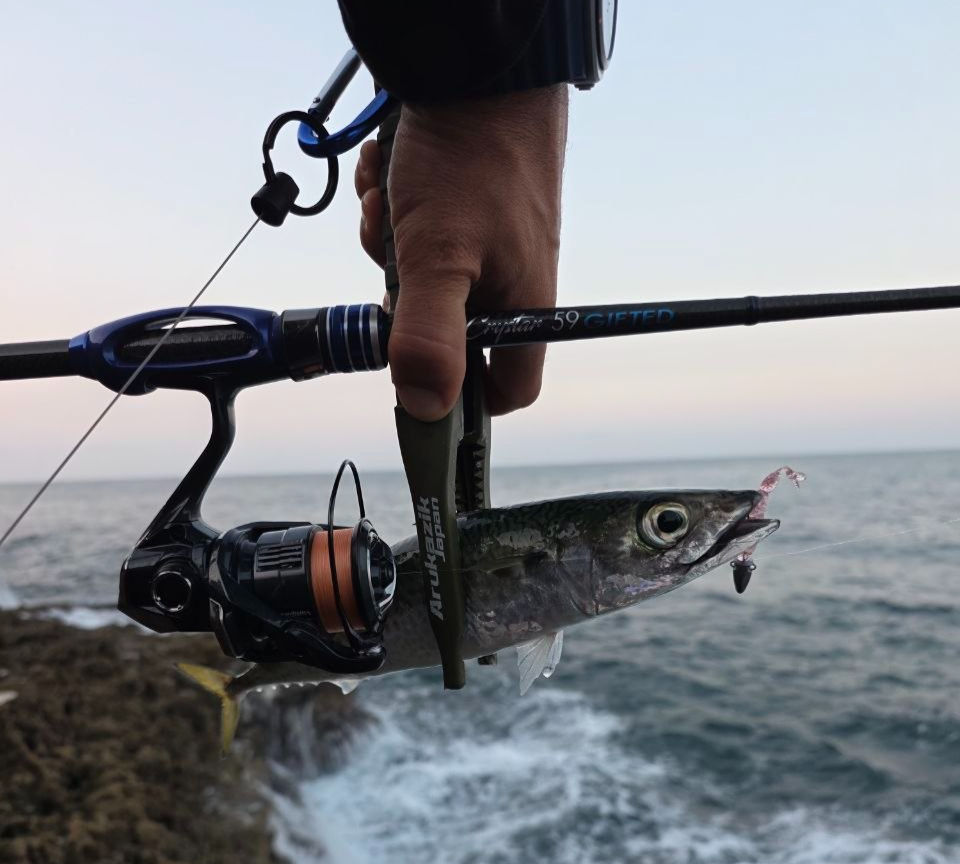
Rod: Clear Blue Crystar 59 Gifted
Reel: Shimano Vanquish CE C2000S
Main line: Gosen Light Game x4 PE 0.2
Leader: Gosen Light Game Fluorocarbon 0.8 Leader length: Approximately 80 cm
The Vanquish C2000S is a brilliant match for the 59 Gifted and has proven itself particularly well when fighting mackerel.
I like fishing as thin as possible, which is why I use PE 0.2.
For someone starting out, however, I wouldn't have a problem recommending PE 0.3 for a little more margin for error.
Despite fishing a relatively fine 0.8 fluorocarbon leader, I've never felt that it was insufficient here.
The key when a serious fish takes the lure isn't brute force. It's patience.
My 1,021 g Mackerel Personal Best
A recent session demonstrated exactly what this setup is capable of.
At around 2 PM, with the tide approaching high water, I was fishing the Bait Breath ST-R 2.1 in OS-07 Green Pumpkin.

A fish took the lure.
And this one was different.
The setup was:
Clear Blue Crystar 59 Gifted
Shimano Vanquish CE C2000S
Gosen Light Game x4 PE 0.2
Gosen Light Game Fluorocarbon 0.8
Arukazik Multi Rock jighead
Bait Breath ST-R 2.1 OS-07 Green Pumpkin
The fight lasted approximately eight minutes.
With PE 0.2, trying to overpower a fish like this makes very little sense.
I let the fish work against the drag.
A big fish needs time.
The objective is to maintain control, keep tension and gradually let the fish tire itself out.
There was one additional problem. I didn't have a landing net.
Eventually I had to guide the fish into a small rock pool to land it, while a crowd of tourists watched the entire fight.
The mackerel weighed 1,021 grams, my personal best.
It's also the reason I now strongly recommend bringing a landing net to this spot, particularly when fishing at low tide.
What I Carry
I like keeping things relatively simple.
Besides the fishing tackle, two things I always want with me are:
Water and a camera. I also carry a fish grip.
And after the experience with the 1 kg mackerel, I'd add a landing net to the recommended equipment.
A normal session for me here lasts around three hours.
Sometimes I fish accompanied by my seven-year-old son, which makes these sessions about considerably more than simply catching fish.
Safety When Fishing the Rocks
This is a rocky fishing area.
That needs to be taken seriously.
The rocks can become extremely slippery, so footwear with excellent grip is essential.
I also recommend wearing a personal flotation device.
Never judge this coastline solely by what it looked like during a previous session.
Conditions can change dramatically.
If the sea becomes too rough, don't fish.
No fish is worth taking unnecessary risks on exposed rocks.
Is Boca do Inferno Suitable for Beginner Ajing Anglers?
I'd say yes in the summer, but with some basic experience.
You should already be comfortable casting and controlling light tackle and, more importantly, moving safely around rocky coastal terrain.
You don't need an extremely complicated technique to start catching fish here.
If I were standing beside someone fishing this area for the first time, I'd give them three instructions:
Let it sink.
Use small pulls and pauses while progressively searching higher through the water column.
If you hook something big, stay calm.
That last one matters.
With genuinely light Ajing tackle, fighting the fish is part of the experience. Let the rod, reel and drag do their jobs.

Catch and Release
I release the large majority of the fish I catch. Probably around 90%.
For me, catching the fish is the experience.
Watching it swim away is often part of that experience too.
Whatever you decide to keep, always respect local fishing regulations, minimum sizes, closed seasons and applicable catch limits.
Frequently Asked Questions About Ajing Fishing in Cascais
Can you fish for Ajing at Boca do Inferno?
Yes. The Boca do Inferno area in Cascais offers good conditions for Ajing and Light Game fishing, with depth, current and rocky structure. Horse mackerel and Atlantic mackerel are my main targets, although other species such as sea bass and seabream can also appear.
What fish can you catch with Ajing in Cascais?
Horse mackerel and Atlantic mackerel are the main species I target around Boca do Inferno. Sea bass, seabream and other species can also be caught, particularly when fishing close to the rocky structure.
What jighead weight should I use for Ajing at Boca do Inferno?
I normally use jigheads between 1 g and 3 g. My choice depends mainly on wind, current and depth. When conditions allow, I prefer lighter jigheads because they give the soft plastic a more natural fall.
What soft plastics work for Ajing at Boca do Inferno?
My main soft plastics for this area are the Arukazik Sankaku 2.0, Namajako 2.4 ST and Bait Breath ST-R 2.1. My personal first choice is the Bait Breath ST-R 2.1 in OS-07 Green Pumpkin.
When is the best time to fish for Ajing in Cascais?

Based on my experience, sunrise and sunset are two of my favourite periods. I've also had good results during the last two hours of both the incoming and outgoing tide. However, fishing conditions can change from day to day.
Is Boca do Inferno suitable for beginner Ajing anglers?
Yes, with some basic fishing experience. The technique itself doesn't need to be complicated, but anglers should be comfortable using light tackle and moving safely around rocky coastline.
What safety equipment should I take when Ajing fishing at Boca do Inferno?
Good footwear with excellent grip and a personal flotation device are important when fishing from the rocks. I also recommend carrying a landing net, particularly when fishing at low tide or when targeting larger fish.
What is the most important tip for Ajing at this spot?
Don't focus on just one depth. Let the lure reach the bottom, then use small pulls and pauses while progressively searching higher through the water column. And keep working the lure until it leaves the water.
I've had fish attack in the final centimetres of the retrieve.
Final Thoughts: Ajing and LRF Around Boca do Inferno
The Boca do Inferno area demonstrates perfectly why I enjoy Ajing.
You have depth.
You have current.
You can search multiple layers of the water column.
You can find horse mackerel and mackerel, but sea bass, seabream and other species can appear when you least expect them.
And sometimes a tiny soft plastic on PE 0.2 connects you to a 1 kg mackerel while a crowd of tourists watches you try to figure out how you're going to land it.
That's Light Game fishing.
If you're going to fish this area, don't become obsessed with a single depth.
Cast long, let the lure reach the bottom, use the current and progressively search the water column.
And never stop fishing the lure until it leaves the water.
The next bite might happen in the last few centimetres.
Tackle Used at This Ajing Spot
This is the Ajing setup I personally use when fishing the Boca do Inferno area.
These aren't theoretical recommendations. They're products I actually use when fishing this area.
Ajing Spots #1 - Boca do Inferno Area, Cascais, Portugal


Comments