
Ajing Fishing on the Setúbal Waterfront: Complete Spot Guide

Horse Mackerel, Light Tackle, Night Fishing & Reading the Waterfront

There is something strangely Japanese about fishing for horse mackerel in Setúbal at night. The lamps point towards the water, the wall creates a clean line of shadow, and small horse mackerel move between light and darkness like little flashes.
This is the second article in my Ajing Spots series, where I share locations I actually fish, the conditions I look for, the techniques I use and the tackle that comes with me. Setúbal is very different from the rocky coastline of Cascais, but that is exactly what makes it interesting.
Most of my Setúbal sessions have taken place around the waterfront. The access is easy, the water is usually calmer than Cascais, and the fishing can become remarkably technical once you start paying attention to current, light, shadow and tiny changes in presentation.
Quick Facts: Ajing in Setúbal
Location: Setúbal waterfront, Portugal
Main target: Horse mackerel
Other species: Atlantic mackerel, shad, weakfish, spotted seabass, seabream, European seabass, garfish, sand smelt and occasional surprises
Best horse mackerel period from my experience: April, May and June
Favourite period: Night
Preferred tide: The beginning of the outgoing tide, while there is still plenty of water
Typical jighead weights: 0.3 g–1 g
Typical soft-plastic size: Up to 2 inches
Key feature: Artificial light, shadow and outgoing current
Access: Easy, with parking close to the waterfront
What Makes Setúbal Interesting for Ajing?
The first thing you notice is how calm the place can feel. Compared with the exposed coastline around Cascais, Setúbal has generally given me calmer conditions, less wind and fewer waves. The bottom around the areas I fish is mostly sand, with some small rocks and structure underneath.
At high tide, the wall can feel almost level with the water. As the tide falls, the vertical distance to the water increases considerably. The outgoing tide also creates a strong movement of water from left to right, and that current is one of the most important things I pay attention to.
There is another detail that makes the place special: the artificial lighting. A lamp illuminates the water while the wall creates roughly a 1.5-metre shadow. The fish often seem to patrol the transition between those two worlds.
The Light and Shadow Line
This is one of the first things I look for at night. I am not simply fishing the illuminated water. I am looking for the point where the light ends and the wall's shadow begins.
My usual approach is to cast towards the illuminated area and allow the soft plastic to move into the shadow. Sometimes I fish directly in the shadow, but from my experience the transition is often more productive.
“The horse mackerels move between the shadow and the light, almost like little flashes in the water.”
That visual aspect is one of the reasons Setúbal reminds me of a Japanese Ajing scene. It is quiet, the lamps are reflected in the water, and the fish can be surprisingly close to the wall.
What Fish Can You Catch in Setúbal?
The answer changes with the season. Horse mackerel are the main reason I enjoy fishing this area, particularly during April, May and June. In a good session in May, 35–40 fish is possible, although the majority are small.

During September, weakfish (Cynoscion regalis) can become extremely abundant. Nights with 40 or 50 captures are possible, with many fish around a hand's length. They are fun for a while, although the action can become repetitive.
Atlantic mackerel are more associated with my daytime sessions here. I have also caught spotted seabass, seabream, shad, European seabass, garfish and sand smelt. When sand smelt move around the area, weakfish (Cynoscion regalis) can attack them. There are also occasional surprises such as larger shad, pompano (Trachinotus ovatus) or the elusive Atlantic bonito.
The Horse Mackerel Bite
One of the things that makes Setúbal's horse mackerel so enjoyable on dedicated Ajing tackle is how subtle the bite can be.
“It feels like someone giving your finger a tiny pinch. Almost like a very faint pulse.”
On a specialised Ajing rod, that little touch can be obvious. On more conventional Light Rock Fishing equipment, I believe a beginner could miss a lot of those first bites until they learn what to feel for.
Most of my horse mackerel bites here have come during the fall. The lure is sinking, I am maintaining contact with the jighead, and then there is that tiny interruption in the sensation. It is not a violent hit. It is a small message through the line and rod.
Reading the Tide and Current
I do not normally check the tide every time I go to Setúbal. The exception is when I am specifically chasing an Atlantic bonito. In general, I like arriving while the tide is still high and fishing through the first two or three hours of the outgoing tide.
For me, the current matters more than the exact height of the water. When the tide starts running out, the baitfish become more active and predators have more opportunities to feed.
The outgoing current generally runs from left to right in the area I fish. When it is moving strongly, I cast towards the left and allow the current to carry the lure to the right while it slowly sinks.
With a stronger current, I move from my usual light weights towards 0.75 g or 1 g. The aim is not to fish heavy for the sake of it. It is simply to maintain control of the jighead.
The Strange Thing About Baitfish
Setúbal often has plenty of small baitfish. They can be seen near the surface, particularly around high water. Normally, that is an encouraging sign.
But Ajing has a way of teaching you not to assume too much.
I have had sessions where there were baitfish jumping everywhere, birds attacking from above and apparently perfect predator conditions, and still no useful activity on the lure.
When that happens, I may change tackle or presentation, but I also remind myself that the fish do not have to be where I expect them to be.
How I Fish Ajing in Setúbal
My approach is deliberately light. I rarely go above a 2-inch soft plastic.
I normally start as light as conditions allow. I want to know what the bottom feels like, so on the first cast I will often let the jighead reach the bottom. After that, I start working the water around the productive zone.
My basic presentation is a slow fall with small touches and short pauses. I may leave the lure still for around one second, then allow it to sink again while maintaining enough contact to know what the jighead is doing.
When the fish are close to the wall, a 0.3 g jighead can be extremely effective. The lighter weight keeps the soft plastic in that small zone for longer.
My most-used weight is around 0.75 g. I move towards 1 g when the outgoing current becomes stronger.
The Three Jigheads I Would Take
Bait Breath Pine Head — 0.3 g
Bait Breath Pine Head — 0.75 g
Clear Blue Mini — 0.6 g
If I could only carry three options for a normal Setúbal night, those would give me a useful spread without turning the tackle box into a suitcase.
Soft Plastics: Keep Them Small
I normally stay at 2 inches or below. During April and May, glittered soft plastics have been particularly productive for me.
The Clear Blue Sexy-B Super Soft has been one of my strongest confidence lures, especially in green. Orange has also worked extremely well for me, although one particular Japanese-exclusive orange colour was not something I could keep supplying in Europe once my personal samples were gone.
Green, orange and pink with glitter would be my three broad colour choices for a Setúbal night. If the fish become difficult, I reduce the profile rather than automatically changing to a larger lure when they become active.
My Personal Ajing Setup

Reel: Shimano Vanquish 1000SSSPG
Main line: Gosen Ester Yellow 0.2
Leader: Gosen Answer Light Game FC Leader 0.8
Jigheads: approximately 0.3–1 g
Soft plastic: Bait Breath Needle Fry 2" and Clear Blue Sexy-B Super Soft, especially green
My first choice for this particular style of Setúbal fishing would actually be the Clear Blue Crystar 56Finder. Unfortunately, the rod sold out very quickly at Ajing Store. I had one available and chose to let a customer have it rather than keep it for myself.
I have been using the Crystar 60 Focus Evolver instead. It is an excellent rod and has advantages in some situations, but for the very delicate close-range horse mackerel fishing I prefer the 56Finder.
Why the Line Matters
I like fishing extremely fine in Setúbal. The difference is not simply sensitivity. A very thin line helps keep the presentation natural and can make a noticeable difference in the number of bites.
Ester is particularly useful here. Even when there is some wind, a very fine ester line helps keep the connection with a tiny jighead. If the wind becomes more difficult, I may increase jighead weight slightly rather than abandoning the light approach.
There is a downside: very fine tackle has limits. A fish rubbing the line against the wall can quickly turn a controlled fight into a problem.
A 1.3 kg Spotted Seabass on Ajing Tackle

One of my most memorable Setúbal captures was a 1.3 kg spotted seabass.
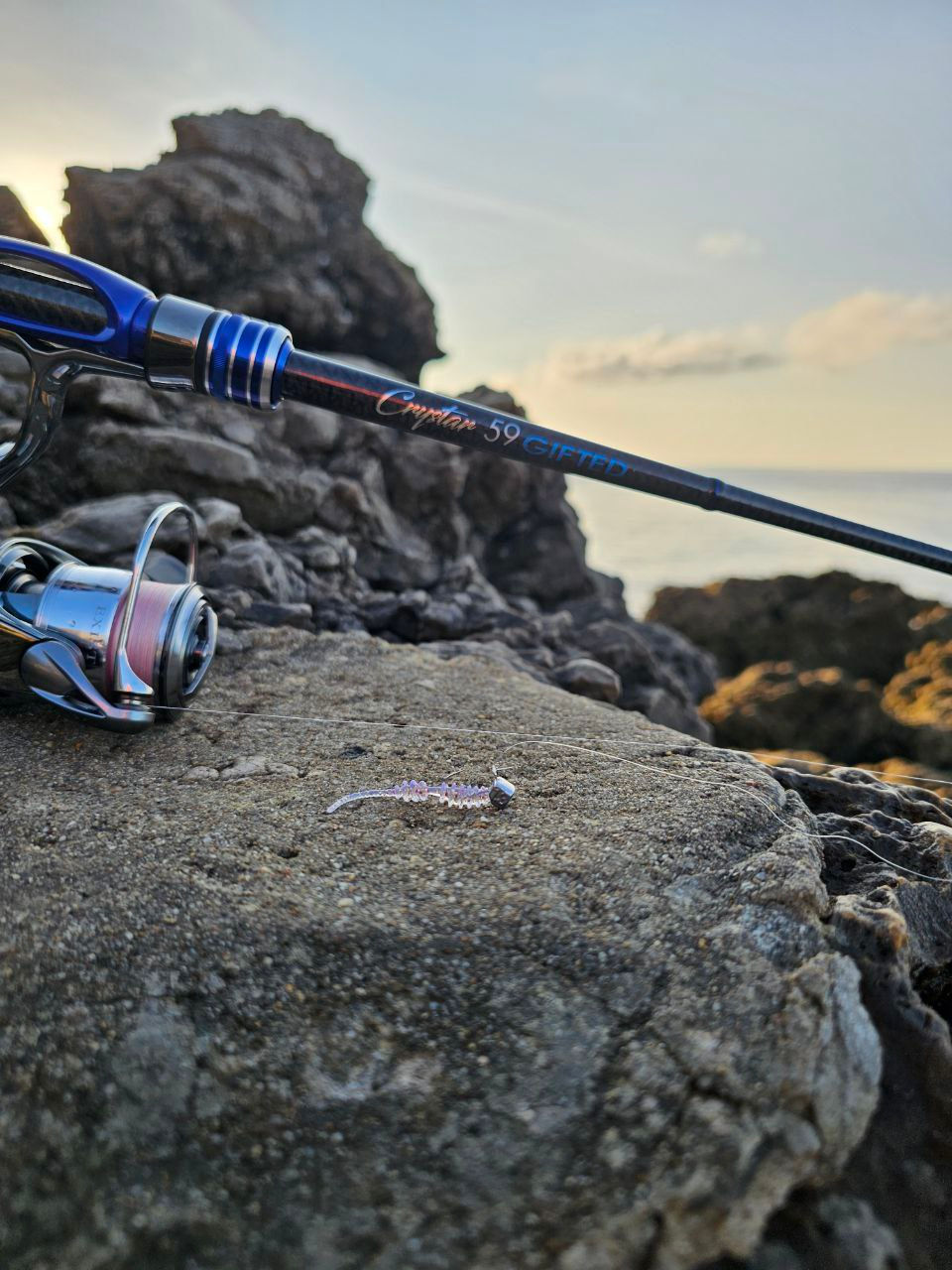
The setup was a Clear Blue Crystar 59GIFTED, Gosen Answer Ajing PE X4 0.2, an Arukazik Multi Rock 1.5 g jighead and a Bait Breath U30 Fish Tail 2.8.
The fish did not initially feel as big as I expected. I only really understood how big it was when it came close to me and I could see it properly.
Then it saw the landing net.
The next few moments were completely different. It made several powerful runs right next to me, and getting it into the net became the difficult part. I spent around five minutes trying to get the fish under control and into the net.
That is one of the things I enjoy about genuinely light tackle. You can never completely predict what will happen when a bigger fish decides it does not want to cooperate.
The Ferry to Tróia
There is another Setúbal feature that I never ignore: the ferry to Tróia.

When it passes, the movement from the engine jets immediately disturbs the water. Sometimes the effect is obvious straight away, and I have caught fish after that disturbance.
Shad can appear, including some close to 2 kg. I do not sit there waiting for the ferry as a deliberate technique, but when it passes, I pay attention.
“Sometimes the best disturbance is the one you didn't create yourself.”
The Fish I Still Haven't Caught
There is one species I am still chasing in Setúbal: Atlantic bonito.
I only started actively looking for one this year. I have seen other people catch them, but I have not yet had that moment myself. No confirmed attack, no fight, no fish in the net.
At this point it is basically another missing card in my fishing collection.
If it happens, I want to do it with the Clear Blue Crystar 59GIFTED. And when it finally does, I suspect I will be equally happy about the attack, the fight and the fact that I can finally tick that fish off the list.
Don't Stay in the Same Place Forever
One of the biggest lessons Setúbal has reinforced for me is the importance of moving.
I often arrive and first look for my friends or fishing companions. If they are catching fish, that gives me a starting point. If the area is not producing, I am perfectly happy to move 150 or 200 metres.
A small change in current can completely change a spot. A boat, a wall, a change in water movement or a slightly different light pattern can make one section productive while another section a short distance away feels completely dead.
This is probably one of the biggest mistakes I see in fishing generally: choosing a spot and then spending hours trying to convince the fish to be there.
What Beginners Usually Get Wrong
The biggest mistake I would expect from a beginner at Setúbal is fishing too heavy. 100%.
The place looks easy. There are people fishing from the wall, the car is nearby and there is no dramatic rocky approach. It is tempting to assume that the fishing must be simple.
But the light tackle is part of what makes the place work.
Start light. Learn what the jighead feels like. Learn the difference between the lure sinking and a fish touching it. Pay attention to the current. Watch the boundary between light and shadow.
And if nothing happens, move.
The Local Fishermen
One of the funniest parts of fishing here is the reaction from conventional anglers.
“What swimming-pool rod is that?”
Or, more directly: “With that rod you're not catching anything.”
Then the small jighead goes into the water and the fish start coming out.
Some of the local fishermen laugh at the tiny rods at first. Others become fascinated when they see how many fish can actually be caught with them. A few have even started asking questions and getting into the technique themselves.
I actually like that part of Ajing. It is not just about catching fish. It is about showing people that there is another way to approach small species.
Catch and Release
I release almost all fish. In a place where it is possible to catch dozens in a session, keeping everything simply does not make sense to me.
Take enough if you are going to keep fish, but there is no need to turn a productive session into a pile of fish.
When handling small fish, I use a grip and pliers where appropriate, and I avoid placing fish directly on hot surfaces. For me, Catch & Release is a fundamental part of Ajing and Light Game fishing.
Always check the current local fishing regulations, minimum sizes, closed seasons and catch limits before fishing.
Safety Around the Setúbal Waterfront
The access is easy, but easy access does not mean zero risk.
The main thing I would pay attention to is the distance to the water. Some sections are low, and wet surfaces can become slippery. Don't become so focused on the next bite that you forget where your feet are.
You do not need a complicated safety kit for the areas I am describing, but sensible footwear and awareness of the edge are always a good idea.
Frequently Asked Questions About Ajing in Setúbal

Is Setúbal good for Ajing?
Yes. Based on my own sessions, Setúbal can be a very productive Ajing area, particularly when horse mackerel are present. The combination of baitfish, artificial light, shadow and tidal current creates several interesting situations.
What fish can you catch with Ajing in Setúbal?
Horse mackerel are the main target for me, but I have also caught Atlantic mackerel, shad, weakfish, spotted seabass, seabream, European seabass, garfish and sand smelt. Larger surprises are possible.
When is the best time for horse mackerel in Setúbal?
From my experience, April, May and June have been the strongest months. May has produced sessions with around 35–40 horse mackerel, although most have been small.
Is night fishing better in Setúbal?
For my style of Ajing, yes. I particularly enjoy the night because of the artificial lighting and the way the fish interact with the transition between light and shadow. Different species can dominate during the day.
What jighead weight should I use?
I normally carry 0.3 g, 0.5 g, 0.75 g and 1 g. My most-used weight is around 0.75 g. I reduce to 0.3 g when fish are close to the wall and increase towards 1 g when the outgoing current becomes stronger.
What soft plastic size works?
I normally stay at 2 inches or below. Green has been my most productive colour, while glittered green, orange and pink have all earned a place in my box.
Should I fish the light or the shadow?
I would start by looking for the transition. From my experience, horse mackerel often patrol the boundary between the illuminated water and the wall's shadow. Casting into the light and allowing the lure to enter the shadow is one approach I use.
What is the most important tip for Ajing in Setúbal?
Stay light, control the fall, watch the current and don't be afraid to move. A spot can be quiet while another section 150–200 metres away is alive.
Final Thoughts: Ajing in Setúbal
Setúbal has become one of those places I can return to without needing a complicated plan. The access is easy, the environment is calm, and on the right nights the fishing can be surprisingly intense.
For me, the horse mackerel are the main attraction. Watching them move between light and shadow, feeling that tiny pinch through a dedicated Ajing rod and then realising how many fish can be sitting almost under your feet is what keeps bringing me back.
But the biggest lesson is not about a particular jighead or lure.
It is about reading the water.
Read the current. Read the light. Look for baitfish. Watch what the tide is doing. And if the fish are not there, move.
I have been doing pure Ajing for around five years now, and I still feel like I know very little. That is probably one of the reasons I enjoy it so much.
“There is always another session, another species, another mistake to understand, and another little piece of the puzzle to figure out.”
And somewhere in Setúbal, there is still an Atlantic bonito waiting to become another card in the collection.
Tackle Used for Ajing in Setúbal
Bait Breath Pine Head 0.3 g / 0.75 g
Clear Blue Sexy-B Super Soft — especially green
Clear Blue Crystar 59GIFTED for heavier or mixed Light Game situations


Comments